Global warehouse buyers are seeking higher storage density without expanding expensive floor space. MHI’s 2024 Annual Industry Report found that 55% of supply chain leaders planned to increase technology investment. Its findings also indicate that automation and artificial intelligence will become more influential by 2029. These shifts make Drive-in Storage increasingly relevant for facilities handling large quantities of similar pallets.
Drive-in racking removes many conventional aisles. A forklift enters the structure, places pallets on deep rails, and reverses carefully. The result can be excellent cubic utilization, especially for cold stores, beverage warehouses, and seasonal inventory. It is not ideal for every product. LIFO operation may reduce direct pallet access, while mixed SKUs can create avoidable handling delays. That limitation deserves attention.
This guide reviews ten Drive-in Storage systems for global buyers. Each option should be judged beyond its catalogue price. Load capacity, tunnel depth, pallet quality, forklift clearance, corrosion resistance, seismic risk, fire protection, and installation support all matter. EN 15635 and ANSI MH16.1 provide useful technical reference points, but local building and fire codes still control final approval.
DHL’s Logistics Trend Radar highlights robotics, data-driven operations, and resilient supply chains as major logistics priorities. Yet, a dense rack is not automatically a smart rack. A poorly designed tunnel can resemble a traffic bottleneck, with damaged rails and slower retrieval. The rankings therefore balance storage density, operational safety, durability, serviceability, and total cost of ownership. Regional prices and performance may differ. No universal winner exists. Careful site measurement remains essential.
What Is a Drive-In Storage System?
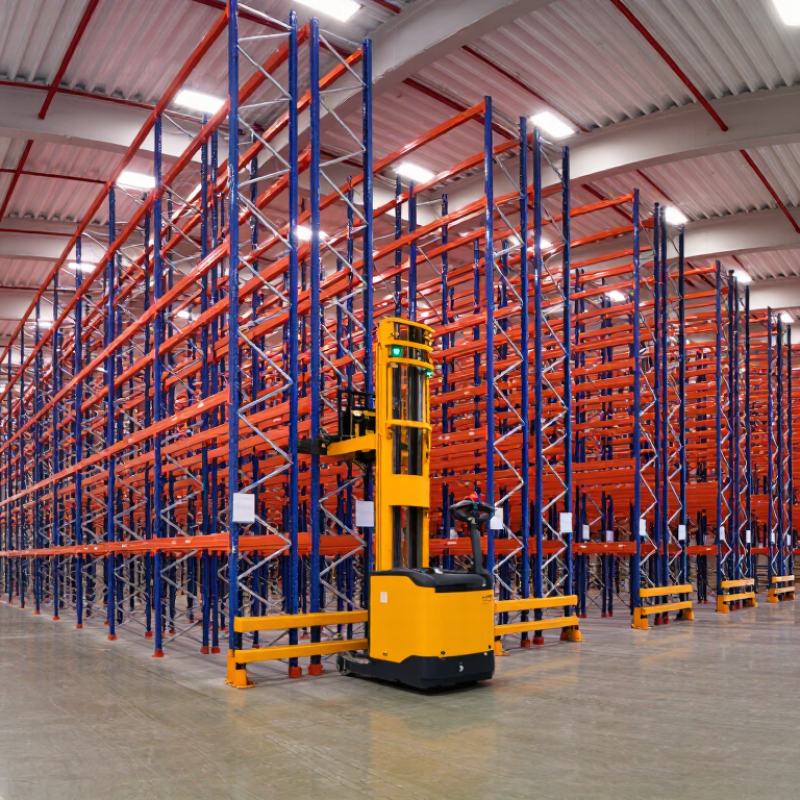
A drive-in storage system is a high-density pallet rack designed for forklifts to enter storage lanes. It removes many access aisles. Steel frames support guide rails, pallet positions, and back stops. Pallets rest on rails at several depths. This layout uses warehouse volume efficiently, especially for uniform goods with limited stock-keeping units. It is not the same as standard selective racking. Access is usually last-in, first-out, because forklifts load and retrieve pallets from one end. Simple in theory.
For global buyers comparing the top 10 drive-in storage systems, the real question is fit, not appearance. Check pallet dimensions, unit weight, forklift clearance, floor flatness, and ceiling height. A freezer warehouse may need corrosion-resistant finishes and materials rated for low temperatures. Load signs should show safe capacities clearly. Operators need controlled speed, accurate entry alignment, and routine inspections for bent rails or damaged frames. One small impact can reduce a lane’s safety margin.
Drive-in racks work best when batches move together and product rotation remains predictable. They can be a poor choice for mixed products, frequent picking, or strict first-in, first-out control. Site surveys sometimes miss turning space at the lane entrance. That mistake is costly. A qualified engineer should verify load calculations, anchoring, seismic requirements, and local workplace rules before installation. I would also test one loaded lane before scaling the design. It can expose awkward forklift movements that drawings may hide.
Key Criteria for Comparing Global Storage Solutions
Comparing drive-in storage systems requires more than counting pallet positions. The World Bank’s 2023 Logistics Performance Index covers 139 economies, highlighting major differences in transport reliability and border performance. Global buyers should therefore assess loading patterns, local handling practices, and delivery frequency before choosing a layout.
Pallet density is the main advantage of drive-in storage, especially for uniform products with low stock rotation. However, high density reduces direct access and often supports LIFO rather than FIFO. Check pallet dimensions, load weights, tunnel depth, rail tolerances, and forklift clearance. A neat spreadsheet can still mislead. Request a realistic loading simulation using your actual pallets and equipment.
Safety and durability deserve equal attention. OSHA reports that forklifts cause about 35,000 serious injuries and 62,000 non-serious injuries annually in the United States. Specify impact protection, rack inspections, floor flatness, seismic requirements, corrosion resistance, and fire-system compatibility. EN 15635 also supports regular rack inspections and documented corrective actions. MHI’s 2024 Annual Industry Report surveyed more than 1,000 supply-chain professionals, reflecting growing interest in connected operations. Yet sensors cannot fix poor discipline. Compare traceability options, inspection records, spare-part access, and installer training. The lowest quote may become expensive when damaged rails, downtime, or difficult retrieval appear.
Top 10 Drive-In Storage Systems for Different Warehouse Needs
Top 10 Drive-In Storage Systems for Different Warehouse Needs
Drive-in storage works best when warehouses handle many pallets with similar products. It reduces aisles and increases usable floor space. A single-entry drive-in system suits last-in, first-out inventory and stable batch storage. A two-entry drive-through design supports first-in, first-out rotation. Deep-lane racks serve high-volume goods with few stock-keeping units. Narrow-lane layouts improve density where forklifts can operate precisely. High-bay drive-in systems use vertical space in buildings with strong clear height. Cold-storage versions help limit temperature loss by reducing open aisles.
Other configurations solve more specific problems. A reinforced drive-in system supports heavier loads and frequent forklift movement. Seismic-ready structures suit regions with measurable earthquake risk. Shuttle-assisted lanes reduce forklift travel inside deep channels. Adjustable lane systems help warehouses manage changing pallet dimensions. These options require accurate load data, floor checks, and careful impact protection. Small mistakes matter.
In daily operation, pallet condition often affects performance more than expected. Damaged boards can catch on rails. Poorly trained drivers may strike uprights or rear stops. Clear lane signs, speed control, and routine inspections improve reliability. Product rotation also deserves attention. A dense system can hide aging stock when workers rely on memory. Some facilities choose drive-in racks for maximum capacity, then discover picking becomes slower. That trade-off is real. The best design depends on turnover, pallet uniformity, forklift dimensions, building height, and safety procedures. Database estimates alone are not enough; on-site observation usually reveals the harder problems.
Top 10 Drive-in Storage Systems for Global Buyers - Top 10 Drive-In Storage Systems for Different Warehouse Needs
| No. |
System Configuration |
Loading Access |
Storage Method |
Typical Selectivity |
Space Utilization |
Best-Suited Warehouse Need |
Key Operating Consideration |
| 1 |
Standard Single-Entry Drive-In |
One side |
Last-in, first-out (LIFO) |
Low to moderate |
Very high |
Large quantities of the same palletized product |
Requires disciplined forklift entry, positioning, and pallet alignment. |
| 2 |
Double-Entry Drive-Through |
Both sides |
First-in, first-out (FIFO) or LIFO |
Moderate |
High |
Stock rotation and warehouses with two-sided material flow |
Needs compatible entry and exit aisles with adequate traffic separation. |
| 3 |
Deep-Lane Drive-In |
Usually one side |
LIFO by storage lane |
Low |
Extremely high |
Seasonal goods and products stored in long batches |
Deep lanes reduce travel aisles but can increase retrieval time. |
| 4 |
Short-Lane Drive-In |
Usually one side |
LIFO by lane |
Moderate |
High |
Facilities handling more product varieties with smaller batches |
Provides better access than deep lanes but normally sacrifices some density. |
| 5 |
Adjustable-Beam Drive-In |
One or both sides |
Primarily LIFO |
Moderate |
High |
Warehouses with changing pallet heights or load requirements |
Beam levels must be adjusted and checked by qualified personnel. |
| 6 |
Cold-Store Drive-In |
One or both sides |
LIFO or FIFO with drive-through layout |
Low to moderate |
Very high |
Frozen and chilled food storage where cubic capacity is valuable |
Corrosion protection, floor flatness, and condensation control are critical. |
| 7 |
High-Load Drive-In |
One or both sides |
LIFO or drive-through FIFO |
Low to moderate |
High |
Dense storage of heavy industrial or bulk pallet loads |
Uprights, rails, floor slabs, and forklift capacity must be engineered for the load. |
| 8 |
Mixed-Depth Drive-In |
One or both sides |
LIFO, organized by product group |
Moderate |
High |
Sites storing products with different turnover rates and batch sizes |
Lane planning is important to prevent inaccessible or misplaced inventory. |
| 9 |
Drive-In with Pallet Supports |
One or both sides |
LIFO or FIFO in a drive-through layout |
Moderate |
High |
Loads requiring additional pallet stability or support |
Support design must match pallet type, load distribution, and deflection limits. |
| 10 |
Hybrid Drive-In and Selective-Rack Layout |
Drive-in plus front-aisle access |
LIFO for bulk stock; FIFO or direct access for fast movers |
Moderate to high |
High |
Warehouses balancing high density with regular access to individual pallets |
Requires clear zoning, inventory rules, and compatible forklift routes. |
Note: Performance descriptions are typical planning characteristics for drive-in pallet-racking layouts. Actual capacity, lane depth, clearances, load ratings, pallet compatibility, and fire-protection requirements must be confirmed through a site-specific engineering review and applicable local regulations.
Installation, Safety, and Maintenance Considerations
Drive-in storage systems save floor space by reducing aisles, but their compact design increases installation risk. The International Labour Organization reports that workplace accidents remain a major global burden, making disciplined warehouse planning essential. Every frame should sit on a surveyed, level floor, with anchors, guards, and load-rated components installed according to engineering drawings. Clearance must match the forklift and pallet dimensions, not only the rack measurements. Small errors matter.
Safety depends on daily behavior. The U.S. Occupational Safety and Health Administration reports about 35,000 serious forklift injuries and 85 fatalities each year. Drive-in lanes need visible load limits, entry guides, impact protection, and one-way traffic controls where possible. Operators should enter squarely and avoid turning inside channels. Supervisors must inspect uprights, rails, anchors, and floor damage routinely. Remove damaged parts immediately. Do not improvise repairs. A perfect layout can still fail through rushed loading.
Tips: Mark every lane clearly. Train operators before handover. Keep pallets consistent in size and condition. Record inspections with photographs and dates. The European standard EN 15635 recommends regular rack inspections by competent personnel, while local rules may require additional checks. Maintenance schedules should reflect actual traffic, not optimistic assumptions. That is easy to overlook. Review the system after product changes, forklift replacement, or a near miss.
Top 10 Drive-in Storage Systems for Global Buyers
Comparative planning index for installation complexity, safety-control requirements, and maintenance intensity. Scores range from 1 (lower demand) to 10 (higher demand); results are general engineering benchmarks and exclude company or brand data.
Lower installation and maintenance scores generally indicate simpler deployment and routine servicing. Safety scores reflect the need for operational controls such as rack protection, load discipline, inspections, traffic management, and operator training.
Conclusion
Drive-in Storage is a high-density warehouse solution designed to maximize floor and cubic space by allowing forklifts to enter storage lanes and place pallets on supported rails. Unlike selective systems, it reduces the number of access aisles, making it especially suitable for large quantities of similar products with relatively low stock rotation. This article explains how the system operates, including pallet loading, retrieval, lane organization, and inventory flow.
It also presents the top ten Drive-in Storage solutions for different warehouse needs, comparing factors such as capacity, pallet dimensions, load requirements, storage density, accessibility, climate, and operational flexibility. Global buyers will gain practical guidance on selecting a suitable configuration, planning installation, and maintaining long-term performance. Special attention is given to structural inspection, forklift movement, lane protection, operator training, emergency procedures, and routine maintenance, helping warehouses improve efficiency while supporting a safe and reliable storage environment.

 Kimsuk Racking