What Are the Best Steel Platforms Made in China?

Time:2026-10-12 Author:Sophia
0%

Choosing the best Steel Platforms made in China requires more than comparing prices or polished product photographs. The right choice depends on load capacity, working height, surface treatment, installation conditions, and long-term maintenance. Chinese manufacturers offer platforms for factories, warehouses, construction sites, mezzanines, and industrial access routes. However, quality can vary significantly between suppliers.

A reliable evaluation begins with practical evidence. Examine welding consistency, steel grades, guardrail strength, stair geometry, and anti-slip surfaces. Ask for load calculations, material certificates, inspection records, and clear production drawings. Galvanized finishes can improve outdoor durability, but coating thickness and preparation methods still matter. Experience from similar installations is also valuable. A supplier serving chemical plants may understand demanding environments better than a general workshop.

Details matter.

This guide considers manufacturers that demonstrate technical competence, transparent communication, and dependable quality control. It also reviews customization, packaging, delivery coordination, and after-sales support. Independent inspections may be worthwhile, especially for elevated platforms carrying people or heavy equipment. No single platform suits every site. That assumption deserves checking.

Some buyers focus too heavily on initial cost. That can be a costly mistake. A cheaper frame may require extra reinforcement, frequent repairs, or difficult installation. The most convincing suppliers explain limitations instead of promising everything. Their documentation should match the finished product, not merely describe an ideal design. By comparing real specifications and project experience, buyers can identify Steel Platforms that balance safety, durability, compliance, and practical value.
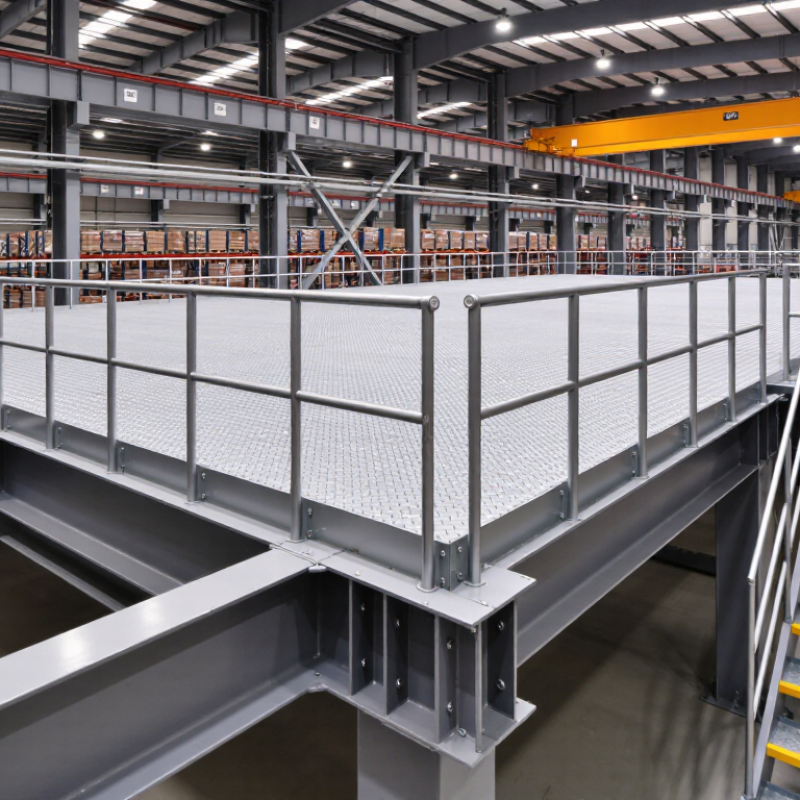
What Are the Best Steel Platforms Made in China?

What Defines a Chinese-Made Steel Platform? Types, Uses, and Load Classes

What Are the Best Steel Platforms Made in China?

A Chinese-made steel platform is defined by more than its factory location. It should show traceable material certificates, controlled welding procedures, dimensional inspection, and documented load testing. China produced about 1.019 billion tonnes of crude steel in 2023, according to World Steel Association data. This scale supports broad manufacturing capacity, but volume alone does not prove platform quality.

The main types include mezzanine platforms, maintenance walkways, loading platforms, stair access systems, and removable work decks. Each serves a different purpose. A warehouse mezzanine may need a uniform distributed load, while a maintenance deck must resist concentrated loads from tools, workers, or equipment.

Designers commonly check permanent loads, live loads, impact effects, guardrail forces, and deflection. Relevant requirements may include GB structural standards, ISO 14122 for permanent access systems, and EN 1090 execution principles.

Load classes need clear wording. “Heavy duty” is too vague. A reliable drawing should state kilograms per square metre, allowable point loads, span limits, surface type, and support spacing. The manufacturer should also provide steel grade, coating thickness, weld inspection records, and installation tolerances.

Practical inspections often find missing assumptions, especially around wheel loads and vibration. That weakness deserves attention. A platform can look rigid yet perform poorly when its real load pattern differs from the design model. Data from the International Organization for Standardization and national structural codes can improve verification, but local engineering review remains essential.

Q235B and Q355B Steel: GB/T 700 and GB/T 1591 Material Standards

What Are the Best Steel Platforms Made in China?

Q235B and Q355B Steel: GB/T 700 and GB/T 1591 Material Standards

Steel platforms made in China should be judged by verified performance, not appearance or factory location. The World Steel Association’s World Steel in Figures 2024 reports China produced 1,019.1 million tonnes of crude steel in 2023. This scale supports extensive fabrication capacity. However, capacity does not replace traceability. Under GB/T 700, Q235B is carbon structural steel with a minimum yield strength of 235 MPa. GB/T 1591 defines Q355B as higher-strength low-alloy structural steel, with 355 MPa minimum yield strength for products up to 16 mm thick. Thickness can change the required values.

Q355B may reduce platform weight while maintaining useful load capacity. Q235B can be a practical choice for moderate loads and simpler structures. Engineers should assess span, live load, vibration, corrosion, welding details, and access conditions. A platform may look rigid but still vibrate under moving equipment. That detail is often underestimated. Inspection records should match heat numbers, thickness measurements, weld inspections, and material certificates. Certificates alone are not perfect evidence; independent testing remains valuable when safety margins are narrow.

Tips: Request original mill certificates and confirm GB/T 700 or GB/T 1591 compliance. Check yield strength, tensile strength, impact requirements, and chemical composition. Ask for dimensional inspection records. For outdoor platforms, review coating thickness and drainage details. Keep a small allowance for fabrication tolerances. Real projects rarely fit drawings perfectly.

What Are the Best Steel Platforms Made in China? — Q235B and Q355B Steel Under GB/T 700 and GB/T 1591
Data Dimension Q235B Steel Q355B Steel Platform Engineering Consideration
Applicable Chinese Material Standard GB/T 700, carbon structural steel GB/T 1591, high-strength low-alloy structural steel Material certificates should identify the applicable standard, steel grade, heat number, thickness, and test results.
Steel Grade Meaning “Q” indicates yield strength; “235” indicates a nominal minimum yield strength of 235 MPa for thin plate; “B” indicates the quality grade. “Q” indicates yield strength; “355” indicates a nominal minimum yield strength of 355 MPa for thin plate; “B” indicates the quality grade. The grade number is not the allowable design stress. Design values must be calculated using the applicable structural design code.
Minimum Yield Strength for Thickness ≤16 mm 235 MPa 355 MPa Q355B provides approximately 51% higher nominal yield strength than Q235B in this thickness range.
Yield Strength with Increasing Thickness Reduces by thickness category; for example, 225 MPa for thickness greater than 16 mm and up to 40 mm. Reduces by thickness category; for example, 345 MPa for thickness greater than 16 mm and up to 40 mm. Always select the yield value corresponding to the actual product thickness, not only the steel grade designation.
Tensile Strength for Thickness ≤16 mm 370–500 MPa 470–630 MPa Tensile strength is only one part of platform performance; connection details, buckling, fatigue, and deflection also require verification.
Minimum Elongation for Thickness ≤16 mm 26% 21% Q235B generally offers greater nominal elongation, while Q355B offers higher strength. The certified value depends on product form and test direction.
Typical Maximum Carbon Content Up to approximately 0.20% by mass, subject to the product and standard requirements. Up to approximately 0.20% by mass, subject to the product and standard requirements. Use the mill certificate for the actual heat chemistry. Weldability should be assessed using carbon equivalent, thickness, restraint, and welding procedure.
Typical Maximum Phosphorus and Sulfur Content Generally up to 0.045% phosphorus and 0.045% sulfur under the standard’s relevant requirements. Generally up to 0.035% phosphorus and 0.035% sulfur under the standard’s relevant requirements. Lower impurity limits in Q355B support more demanding structural applications, but fabrication controls remain necessary.
Impact Toughness Classification Quality grade B includes impact-toughness provisions at a positive temperature as specified by GB/T 700 and the ordered product. Quality grade B includes Charpy V-notch impact requirements at 20°C under GB/T 1591. Confirm test temperature, absorbed-energy requirement, specimen direction, and thickness applicability in the purchase specification.
Approximate Density 7,850 kg/m³ 7,850 kg/m³ Changing from Q235B to Q355B does not significantly reduce density. Weight savings usually come from an optimized structural design and reduced member thickness.
Weldability Generally good weldability when suitable welding consumables and procedures are used. Generally weldable, but preheating, heat input, interpass temperature, and hydrogen control may become more important as thickness and restraint increase. Welding should follow an approved welding procedure specification and be performed by qualified personnel.
Recommended Platform Position Suitable for light-to-moderate duty walkways, maintenance platforms, stairs, frames, handrail supports, and general fabricated structures when verified by design. Suitable for heavily loaded platforms, longer spans, transfer areas, equipment-support frames, and structures where member size or deflection control is critical. Actual suitability depends on live load, span, support conditions, vibration, impact, seismic requirements, environment, and connection design.
Potential Structural Advantage Lower material grade cost and straightforward fabrication for many ordinary platform applications. Higher strength can enable smaller sections, thinner plates, or greater load capacity, subject to buckling and serviceability checks. Higher-strength steel is not automatically the most economical option if fabrication, connection, inspection, or local buckling requirements increase.
Corrosion Protection Requires a suitable coating system, galvanizing, or other corrosion-protection method for outdoor or corrosive environments. Requires the same type of corrosion-protection planning; higher strength does not make the steel inherently corrosion-resistant. Specify surface preparation, coating thickness, galvanizing requirements, drainage, and inspection criteria separately from the steel grade.
Key Procurement Documents Material test certificate, dimensional inspection record, welding documentation, coating report, and load-test or inspection records where required. Material test certificate, dimensional inspection record, welding documentation, coating report, and load-test or inspection records where required. Purchase documents should state steel standard, grade, product form, thickness, impact requirements, tolerances, inspection level, and applicable design code.
Best Selection Approach Choose when the calculated design strength, deflection, stability, and durability requirements are satisfied without unnecessary material upgrading. Choose when higher strength or reduced member size provides a verified structural, weight, or serviceability benefit. There is no universally “best” grade; the correct choice is the one that meets the project loads, safety factors, fabrication capability, and lifecycle requirements.
Note: Values shown are representative requirements or engineering reference values for common plate thickness ranges. The latest edition of GB/T 700, GB/T 1591, the product certificate, and the project’s structural design code take precedence.

Platform Performance: 2.0–5.0 kN/m² Loads and Deflection Limits

What Are the Best Steel Platforms Made in China?

Platform Performance: 2.0–5.0 kN/m² Loads and Deflection Limits

Choosing the best steel platforms made in China starts with performance, not appearance. Working decks commonly require loads from 2.0 to 5.0 kN/m². A 2.0 kN/m² platform may suit light maintenance access. A 5.0 kN/m² design better supports storage or busy industrial areas. Actual use must control the selection. Point loads, rolling equipment, and impact can change the calculation. They should not disappear behind one uniform-load figure.

During factory inspections, evaluators check steel thickness, weld continuity, hole alignment, and coating coverage. Small defects matter. A platform can meet its load rating yet vibrate excessively. Engineers should verify beam bending, connection strength, vibration, and serviceability deflection. Common limits include L/360 for walking surfaces, while some projects accept L/240. These ratios are not universal. The project engineer must confirm the governing code and span condition. Reliable suppliers provide drawings, material certificates, weld procedures, and inspection records.

Deflection is visible in practice. A three-metre beam limited to L/360 should deflect no more than about 8.3 millimetres. Users may notice movement before structural failure. Specifications are sometimes copied without checking actual spans. That is a costly shortcut. Compare platforms by working-load capacity, deflection, drainage, slip resistance, and maintenance access. Independent review is sensible when platforms support people or valuable equipment. The strongest option is the one whose calculations and fabrication records agree.

Leading Chinese Manufacturers: Certifications, Capacity, and Quality Data

What Are the Best Steel Platforms Made in China?

The strongest Chinese steel platform suppliers show evidence, not polished promises. Look for ISO 9001 quality systems, material certificates, welding procedure records, and factory inspection reports. Certifications should match the product and destination market. A certificate alone proves little.

Ask for measurable capacity data. A serious manufacturer can state annual output, maximum platform dimensions, steel grades, and typical lead times. Factory photographs should show cutting, welding, galvanizing, and load testing areas. For quality control, request mill certificates, weld inspection results, coating thickness records, and dimensional reports. Independent testing is more convincing than internal claims. However, data can be incomplete or outdated. Treat that as a warning, not a small detail.

Tips: Confirm each certificate with the issuing body. Request a recent sample report. Compare declared load ratings with engineering calculations. Check whether the quoted capacity includes workers, tools, dynamic movement, and safety margins. Visit the facility when possible, or hire an independent inspector. Small defects matter. I have seen projects delayed by unclear drawings and missing bolt specifications, even when the steel itself was acceptable. A reliable supplier should revise drawings, explain tolerances, and document corrective actions without becoming defensive. Payment terms, packaging details, corrosion protection, and after-sales response also deserve written confirmation. Quality is not only the platform; it is the evidence behind every platform.

Supplier Comparison: ISO 9001, Welding Tests, Costs, and Lead Times

When comparing steel platforms made in China, start with evidence rather than catalog photographs. An ISO 9001 certificate shows a quality management system, not perfect workmanship. Check its scope, expiry date, issuing body, and production address. Request material certificates for the specified steel grade. A serious supplier should link heat numbers to delivered components. This small detail often separates traceable production from reassuring paperwork.

Welding deserves direct scrutiny. Ask for welder qualifications, welding procedure records, and recent visual inspection reports. For load-bearing joints, independent magnetic-particle or ultrasonic testing may be appropriate. Review sample photos closely: uneven fillets, undercut edges, and spatter can signal rushed work. I would not accept a generic “passed inspection” statement. The required test level should match the platform’s load, environment, and design drawings.

Compare costs line by line, including steel thickness, surface treatment, stairs, handrails, packaging, testing, and inland delivery. A cheaper quotation may simply omit these items. Lead time needs equal care. Separate drawing approval, fabrication, inspection, and shipping time. For a typical project, ask for milestone dates and a practical change window. Factory capacity can shift during peak seasons. That uncertainty is easy to underestimate. My own comparison would also allow a contingency, because the fastest promised schedule is rarely the most reliable one.

FAQS

What load range is common for steel platforms?

Working decks commonly handle 2.0 to 5.0 kN/m².

How should platform loads be calculated?

Engineers should include workers, tools, stored materials, rolling equipment, and impact. Point loads can change the design significantly. Do not hide these forces behind one uniform-load figure. That shortcut is risky.

What deflection limit is commonly used?

Walking surfaces often use an L/360 deflection limit. Some projects accept L/240, depending on the governing code. A three-metre beam at L/360 allows about 8.3 millimetres of movement. Users may notice vibration before structural failure.

What should factory inspectors check?

Inspectors should check steel thickness, weld continuity, hole alignment, and coating coverage. They should also review beam bending and connection strength. Small defects matter. A platform can meet its load rating yet feel uncomfortable.

Which documents should a supplier provide?

Request drawings, material certificates, welding procedure records, and inspection reports. Useful records include coating thickness and dimensional reports. Heat numbers should connect the steel to delivered components. Missing traceability deserves attention.

How can welding quality be evaluated?

Ask for welder qualifications and recent visual inspection records. Load-bearing joints may require magnetic-particle or ultrasonic testing. Look for undercut edges, uneven fillets, and excessive spatter. A generic “passed inspection” statement is not enough.

How should steel platform quotations be compared?

Compare steel thickness, surface treatment, stairs, handrails, packaging, testing, and inland delivery. A low quotation may exclude important items. Check whether the price includes required safety features. Cheap is not always cheaper.

How should delivery schedules be reviewed?

Separate drawing approval, fabrication, inspection, and shipping time. Request milestone dates and a realistic period for design changes. Factory capacity may change during peak seasons. The fastest promise may be unreliable. I would include contingency time.

Conclusion

Chinese-made Steel Platforms are designed for industrial, commercial, and infrastructure applications, including factory walkways, equipment supports, storage areas, and access systems. Their quality depends on structural design, fabrication accuracy, surface treatment, and compliance with applicable Chinese standards. Common materials include Q235B steel under GB/T 700 and Q355B steel under GB/T 1591, with the latter offering higher strength for demanding applications. Platform selection should consider intended use, span, safety factors, corrosion conditions, and expected live loads, commonly ranging from 2.0 to 5.0 kN/m². Deflection limits, weld quality, connection design, and stability are also essential performance indicators.

When comparing Chinese manufacturers, buyers should review ISO 9001 certification, material traceability, welding procedures, inspection records, production capacity, and load-test data. A reliable supplier should provide clear technical drawings, dimensional tolerances, coating specifications, and evidence of welding qualifications. Cost and lead time are important, but they should be evaluated alongside engineering support, quality consistency, packaging, and delivery reliability. A structured comparison helps buyers select Steel Platforms that balance safety, durability, compliance, and overall project value.

Sophia

Sophia

Sophia is a dedicated marketing professional with an exceptional depth of knowledge about her company's products and services. With a keen understanding of market trends and customer needs, she crafts insightful blog posts that not only inform but also engage readers, enriching the company’s online......